Use the sourcing toolkit behind this workflow.
Get supplier onboarding, due-diligence tracking, landed-cost planning, RFQ and PO control, production specs, inspection tools, defect logs, and compliance tracking in one connected system.
The cheapest supplier is not always the cheapest mistake.
That is why simple quote comparison is not enough before your first bulk order.
Two suppliers can look similar in price while being very different in:
- communication quality,
- packaging discipline,
- sample consistency,
- lead time reliability,
- willingness to confirm details in writing.
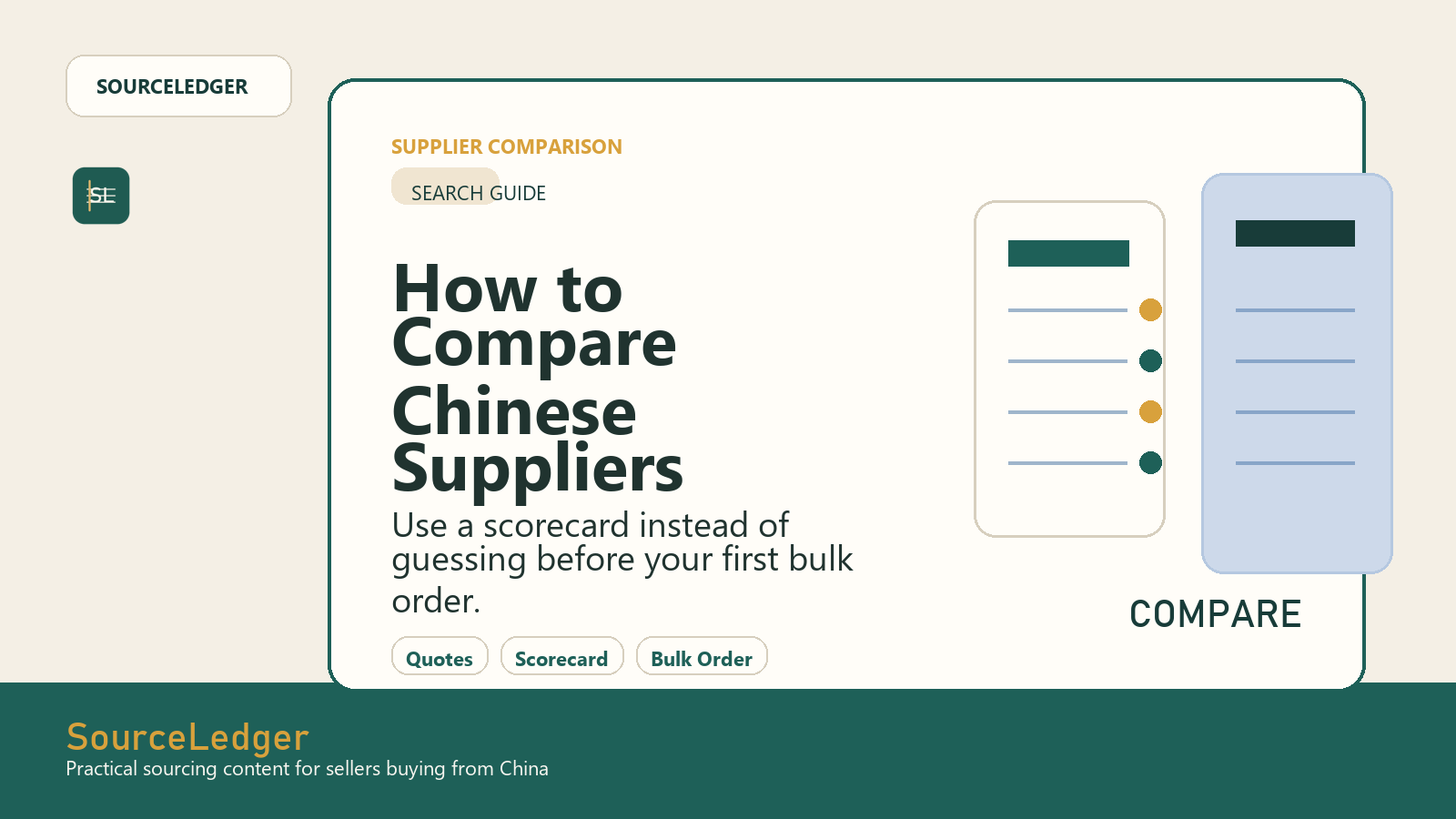
If you want a cleaner sourcing process, compare suppliers with a scorecard instead of a gut feeling.
The strongest version of that scorecard is not price-only. It should sit next to a supplier onboarding questionnaire, due-diligence tracker, landed-cost model, and production spec sheet so you can see both commercial fit and execution risk.
What you should compare besides price
Price matters, but it should not dominate the whole decision.
A practical supplier comparison should include:
- unit price,
- MOQ,
- sample speed,
- lead time,
- response speed,
- communication clarity,
- packaging flexibility,
- defect or risk notes.
You are not just buying a product. You are buying execution.
A simple supplier comparison scorecard
Use a 1 to 5 score for each area.
1. Quote quality
Ask:
- Was the quote complete?
- Did the supplier answer the exact RFQ?
- Did they clearly state assumptions?
2. MOQ fit
Ask:
- Does the MOQ fit your first-order risk?
- Is MOQ per color or per SKU?
- Was there any flexibility for a trial order?
3. Sample responsiveness
Ask:
- How quickly did they confirm sample details?
- Did they answer clearly on cost and timing?
- Did the sample match what was discussed?
4. Lead time credibility
Ask:
- Is the lead time realistic?
- Does the supplier explain what drives the schedule?
- Do they sound organized or just eager to say yes?
5. Communication quality
This is one of the most underrated signals.
Look for:
- direct answers,
- clean written confirmations,
- willingness to clarify,
- consistency across messages.
If communication is already messy before production, it usually gets worse under pressure.
6. Packaging and labeling flexibility
Small brands often need:
- barcodes,
- warning labels,
- carton marks,
- simple retail packaging,
- insert cards.
If the supplier struggles here, that friction will show up again later.
7. Risk notes
Keep one column for qualitative risk:
- vague answers,
- changing assumptions,
- unrealistic promises,
- weak sample quality,
- refusal to confirm details in writing.
This column often explains why the "cheapest" supplier becomes expensive later.
If you want a scorecard instead of a blank spreadsheet
China Sourcing Ops Kit includes a ready-to-use Supplier Comparison Scorecard plus supplier onboarding, due-diligence tracking, landed-cost planning, and production controls so you can compare quotes, execution fit, and risk in one place.
A simple weighting model
If you want a cleaner decision, weight the criteria like this:
- quote quality: 20%
- landed cost fit: 20%
- communication quality: 20%
- MOQ fit: 10%
- sample quality and speed: 15%
- lead time credibility: 10%
- packaging flexibility: 5%
You do not need perfect math. You need a repeatable way to avoid impulsive decisions.
Red flags to watch for early
The supplier avoids specific answers
If you ask for carton size, lead time, or packaging confirmation and get fuzzy replies, log it.
The supplier changes assumptions between messages
That often leads to quote drift later.
The supplier says yes to everything too quickly
Fast agreement sounds good until production starts and details were never really checked.
The supplier treats your first order like a distraction
Not every factory is a fit for smaller brands, and that is fine. The mistake is trying to force the fit.
A quick example
Imagine three suppliers:
- Supplier A is lowest on price but vague on packaging and slow on follow-up.
- Supplier B is slightly higher but clear, structured, and flexible on a smaller trial MOQ.
- Supplier C is fast and friendly but avoids answering defect-handling questions.
On unit price alone, A might win.
On a real scorecard, B often becomes the stronger choice because the order is easier to manage, easier to inspect, and easier to reorder.
What to do after you score suppliers
Use this decision flow:
- remove any supplier with major communication or credibility red flags,
- compare landed cost instead of unit price only,
- move the top candidates to sample review,
- confirm packaging and production assumptions in writing before bulk.
This makes your first bulk order much less fragile.
The practical next step
If you want a ready-made Supplier Comparison Scorecard, Landed Cost Calculator, RFQ Template, Purchase Order Template, supplier due-diligence tools, and sourcing checklists in one workflow, use China Sourcing Ops Kit.
If you are still earlier in the process, start with the free 8 Supplier Email Templates for China Sourcing and clean up your supplier communication first.
Related reading:
FAQ
Should I pick the supplier with the lowest unit price?
Not by default. Compare landed cost, communication quality, sample quality, and packaging discipline before making the call.
How many suppliers should I compare before a first bulk order?
Three to five serious suppliers is usually enough to see pricing patterns, communication differences, and which factories are actually a fit.
What matters more: quote speed or quote quality?
Quote quality. A fast but vague quote often creates more confusion later than a slightly slower quote with clear assumptions and details.
About SourceLedger
SourceLedger publishes practical sourcing guidance for Amazon FBA sellers, Shopify founders, and small brands buying from China. The focus is simple: clear workflows, better supplier communication, cleaner quoting, and fewer avoidable sourcing mistakes.
Turn this article into a controlled sourcing workflow.
If you want the full operating system behind the article, move into the toolkit. If you are still shaping supplier conversations, start with the free supplier email pack.