Use the sourcing toolkit behind this workflow.
Get supplier onboarding, due-diligence tracking, landed-cost planning, RFQ and PO control, production specs, inspection tools, defect logs, and compliance tracking in one connected system.
A supplier quote is not your landed cost.
That sounds obvious, but it is one of the easiest mistakes to make when sourcing from China.
You see a quote of $2.80 per unit and think you have room. Then packaging, freight, inspection, payment fees, and duty show up, and your margin looks completely different.
If you sell on Amazon FBA or Shopify, landed cost is the number that matters because it shapes:
- pricing,
- margin,
- reorder timing,
- how much mistake room you have.
What landed cost actually means
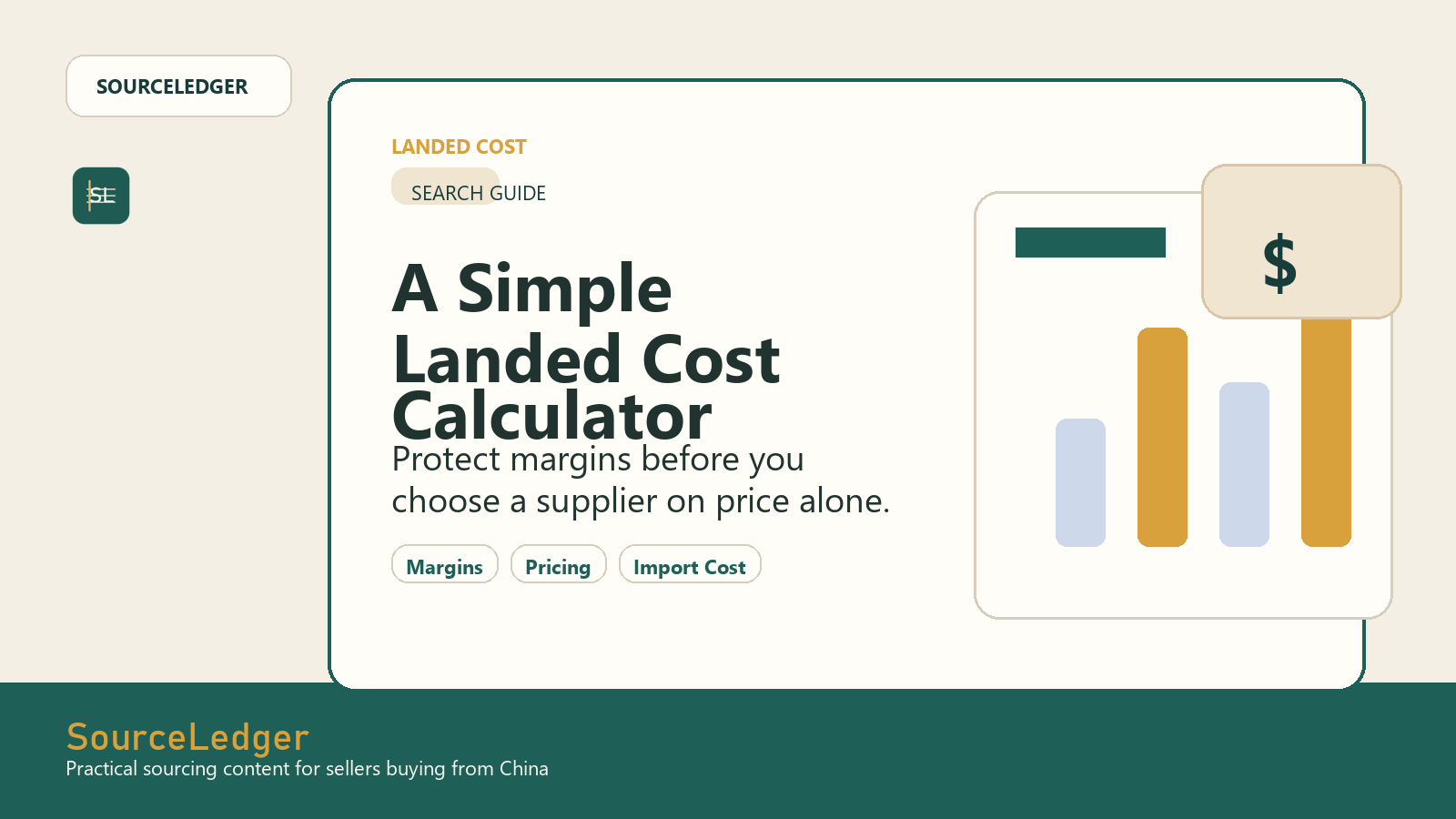
Landed cost is the total cost to get one sellable unit ready for your business.
At a practical level, that usually includes:
- product cost,
- packaging cost,
- inland shipping in China if relevant,
- international freight,
- duty or tariff,
- inspection cost,
- payment fee,
- miscellaneous sourcing costs.
For marketplace sellers, landed cost is not the final profitability picture. You still need to account for channel fees, storage, advertising, returns, and fulfillment. But landed cost is the clean starting point.
The simple landed cost formula
Use this working structure:
Total landed cost = product + packaging + inland shipping + freight + duty/tariff + inspection + payment fee + miscellaneous
Then:
Landed cost per unit = total landed cost / sellable units
The word sellable matters. If you expect damage, defects, or waste, use the number of units you can actually sell.
The fields you should track
A basic landed cost sheet should include:
- product cost per unit,
- packaging cost per unit,
- order quantity,
- inland freight,
- international freight,
- duty or tariff,
- inspection fee,
- payment processing fee,
- other one-off costs,
- total landed cost,
- landed cost per unit,
- target selling price,
- margin estimate.
If you want the calculator instead of the theory
China Sourcing Ops Kit includes a ready-made Landed Cost Calculator so you can plug in quotes, freight, inspection, and fee assumptions right away.
It also keeps the cost model connected to supplier comparison, RFQ control, production planning, inspection results, and issue tracking so the final sourcing decision is not made from price alone.
A quick example
Let us say you are buying 500 units.
- product cost:
$2.80 - packaging cost:
$0.25 - inland shipping:
$120 - freight:
$640 - inspection:
$180 - payment fee:
$75 - misc cost:
$55
Ignoring duty for the moment, your landed total is:
(500 x 2.80) + (500 x 0.25) + 120 + 640 + 180 + 75 + 55 = $2,595
Landed cost per unit:
$2,595 / 500 = $5.19
That is a very different number from the original factory quote.
The costs small brands most often miss
Packaging assumptions
If the supplier quotes the product only and you later add a retail box, insert, barcode, or warning label, your per-unit cost changes.
Inspection fees
Many buyers skip inspection in the model because it feels optional. It is optional only until one bad order wipes out the savings.
Payment fees
Wire fees, platform fees, and other transaction costs are not huge line by line, but they still belong in the model.
Waste or defect allowance
If 3 percent of units are unsellable, your effective landed cost per good unit goes up.
Rework and delay costs
These are harder to model in advance, but they are exactly why you should leave margin room instead of pricing too tightly.
Why landed cost beats unit price
Two suppliers can quote:
- Supplier A: lower unit price, worse packaging assumptions, slower communication
- Supplier B: slightly higher unit price, cleaner carton dimensions, clearer spec control
Supplier B can still be the better business choice once you look at landed cost, defect risk, and operational friction.
This is why the right workflow is:
- send a structured RFQ,
- collect comparable quotes,
- calculate landed cost,
- compare suppliers using both cost and execution quality.
How Amazon and Shopify sellers should use this number
For Amazon FBA
Use landed cost as your sourcing-side baseline before layering in marketplace economics.
Then compare it against:
- referral fees,
- fulfillment fees,
- storage,
- return rates,
- ad spend.
Amazon's own revenue calculator is useful for channel-side math. Your landed cost sheet is what keeps the sourcing side honest.
For Shopify
Use landed cost to test:
- pricing room,
- discount room,
- shipping subsidy room,
- bundle economics,
- wholesale margin if you add B2B later.
A practical rule of thumb
Never approve a supplier based on factory price alone.
At minimum, compare suppliers using:
- landed cost per unit,
- MOQ,
- sample quality,
- lead time,
- response quality,
- packaging flexibility.
The practical next step
If you want a ready-to-use landed cost sheet instead of building one from scratch, China Sourcing Ops Kit includes a Landed Cost Calculator, Supplier Comparison Scorecard, RFQ Template, production controls, inspection summaries, and issue-tracking files that keep the cost model tied to the real sourcing decision.
If you are not ready for the full toolkit yet, start with the free 8 Supplier Email Templates for China Sourcing and tighten your supplier communication first.
Related reading:
FAQ
What is the difference between unit price and landed cost?
Unit price is only the factory quote. Landed cost includes the other sourcing-side costs needed to get a sellable unit ready for your business.
Should Amazon sellers use landed cost before checking FBA fees?
Yes. Landed cost is the sourcing baseline. After that, layer on Amazon fees, storage, returns, and ad spend to model the full margin picture.
Can a higher factory quote still lead to a better landed cost outcome?
Yes. Better packaging assumptions, clearer communication, and lower execution risk can easily outweigh a slightly lower unit price from a weaker supplier.
About SourceLedger
SourceLedger publishes practical sourcing guidance for Amazon FBA sellers, Shopify founders, and small brands buying from China. The focus is simple: clear workflows, better supplier communication, cleaner quoting, and fewer avoidable sourcing mistakes.
Turn this article into a controlled sourcing workflow.
If you want the full operating system behind the article, move into the toolkit. If you are still shaping supplier conversations, start with the free supplier email pack.