Use the full sourcing toolkit.
Get calculators, scorecards, RFQ templates, purchase orders, checklists, and supplier scripts in one ready-to-use system.
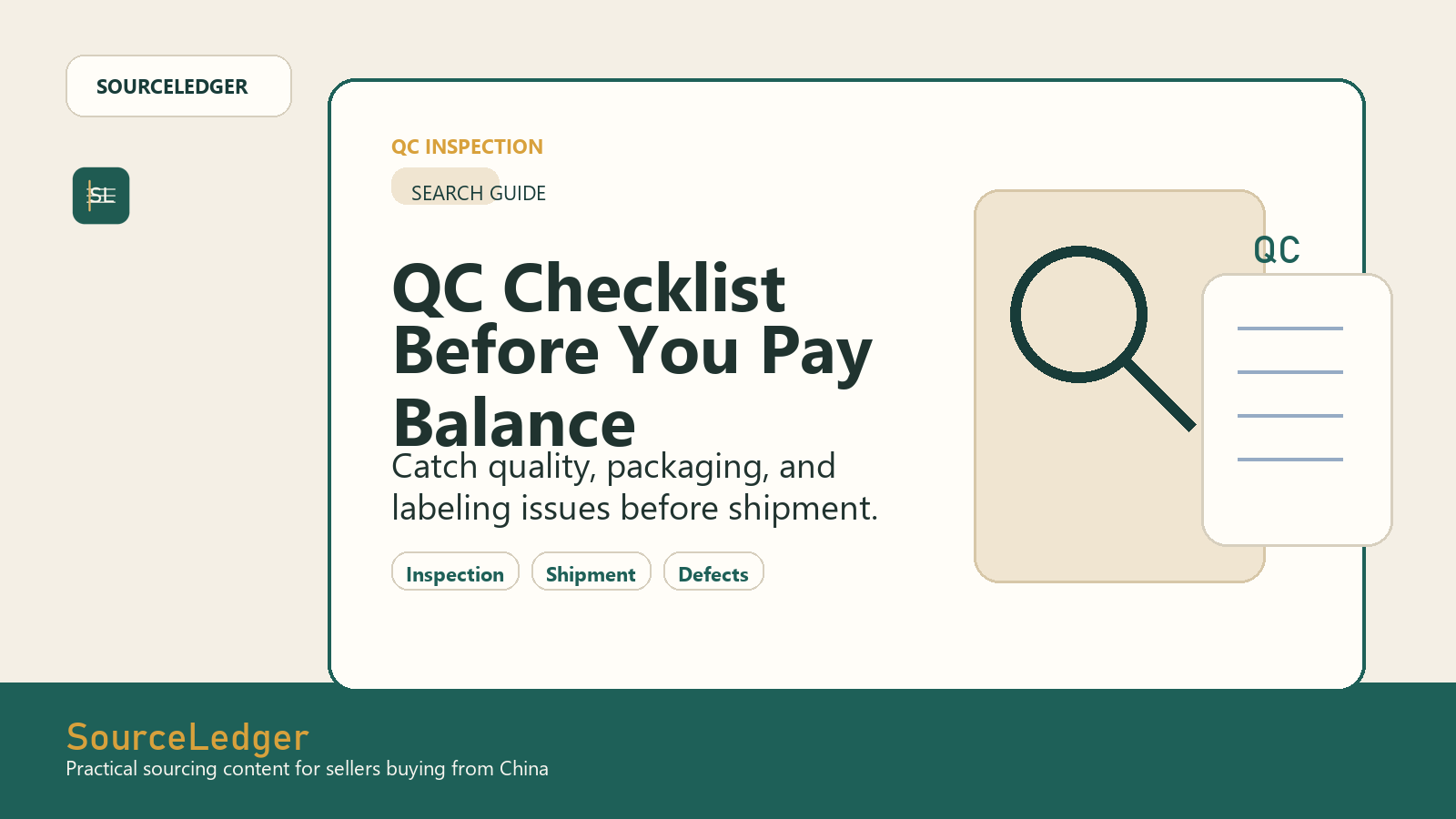
One of the worst times to discover a quality problem is after you already paid the balance.
At that point, your leverage is lower, the shipment is close, and every delay feels expensive.
That is why a practical QC inspection checklist matters so much for small brands buying from China.
You do not need a giant corporate quality system. You do need a clear pre-shipment decision gate.
Why this moment matters
Before balance payment, you still have room to:
- hold shipment,
- request rework,
- ask for replacements,
- negotiate credit,
- clarify missing labels or packaging issues.
After payment and shipment, your options are weaker and slower.
What to inspect before you pay
Your checklist should cover five areas.
1. Visual quality
Check for:
- scratches,
- dirt,
- color inconsistency,
- poor finish,
- logo placement issues,
- obvious assembly defects.
If you approved a sample, compare the goods against the approved reference, not your memory.
2. Dimensions and spec
Check:
- size,
- weight if relevant,
- thickness,
- fit,
- key tolerance points.
Do not assume the factory interpreted the spec sheet the same way you did.
3. Function
If the product has a function, test it.
Examples:
- lids close properly,
- pumps or spray mechanisms work,
- zippers run cleanly,
- chargers or cables connect correctly,
- moving parts feel consistent.
4. Packaging and labeling
This is where many ecommerce sellers lose time.
Confirm:
- retail box or polybag format,
- insert cards,
- barcodes,
- FNSKU or marketplace labels if relevant,
- warning labels,
- carton marks,
- carton count and packing consistency.
If your packaging is wrong, the order can still be "manufactured" but not actually ready to sell.
5. Carton condition and quantity
Check:
- outer carton damage,
- weak sealing,
- carton size consistency,
- quantity per carton,
- total packed quantity.
Freight and warehouse problems often start here.
If you want the checklist in a ready-to-use format
China Sourcing Ops Kit includes a QC Inspection Checklist, Pre-Production Checklist, and Claim and Defect Handling Pack so you can inspect, document issues, and escalate more cleanly.
A practical pass-fail framework
Do not inspect randomly. Decide in advance what counts as:
- acceptable,
- rework required,
- hold shipment,
- reject.
Examples:
Acceptable
- small cosmetic variation that does not affect retail quality,
- carton scuffing without product risk,
- tiny spec drift within your tolerance.
Rework required
- missing labels,
- wrong insert card,
- obvious logo placement issue on part of the batch,
- packaging mismatch that can be corrected quickly.
Hold shipment
- repeated functional failures,
- large packaging inconsistency,
- spec mismatch against approved sample,
- defect rate that threatens sellability.
The evidence you should collect
Before you raise an issue, collect clean evidence:
- clear photos,
- short defect notes,
- carton photos,
- quantity summary,
- sample count if relevant,
- pass/fail decision by issue type.
If the issue becomes a refund, credit, or remake discussion later, evidence quality matters.
A simple message to send your supplier
Subject: Pre-shipment quality issues for review
Hello [Supplier Name],
We reviewed the order and found issues that need to be resolved before shipment.
Main issues:
- [issue 1]
- [issue 2]
- [issue 3]
We have attached photos and notes for reference.
Please confirm:
- the cause of the issue,
- what can be reworked before shipment,
- the updated timeline,
- your proposed solution for any units that cannot be corrected.
We would like to resolve this before balance payment and shipment release.
Best regards, [Your Name]
Common inspection mistakes
Mistake 1: checking product only and ignoring packaging
For ecommerce sellers, packaging and labeling are part of product readiness.
Mistake 2: paying based on trust alone
Good relationships help, but the batch still needs to match the approved standard.
Mistake 3: raising issues without organized evidence
Vague complaints lead to vague responses.
Mistake 4: treating every issue as a disaster
Some issues need rework. Some need a shipment hold. Some are minor and acceptable. Use a decision framework instead of reacting emotionally.
When to bring in a third-party inspection
If the order value is meaningful, the product is sensitive, or the batch is hard to judge remotely, a third-party inspection can be worth it.
This article is a practical operator checklist, not a replacement for professional inspection services where the risk justifies them.
The practical next step
If you want a ready-to-use QC Inspection Checklist, Pre-Production Checklist, Reorder Checklist, Claim and Defect Handling Pack, and the templates around them, use China Sourcing Ops Kit.
If you need better supplier communication first, start with the free 8 Supplier Email Templates for China Sourcing.
Related reading:
FAQ
Do I always need a third-party inspection?
Not always. But if the order value is meaningful, the product is sensitive, or quality is hard to judge remotely, it is often worth considering.
Should I pay the balance before packaging and labeling are checked?
Usually no. Packaging and labeling are part of product readiness, especially for ecommerce sellers with barcode or marketplace requirements.
What is the biggest pre-shipment mistake small brands make?
Paying too early without a clear pass-fail standard, clean evidence, and a written plan for how defects will be handled if issues show up.
About SourceLedger
SourceLedger publishes practical sourcing guidance for Amazon FBA sellers, Shopify founders, and small brands buying from China. The focus is simple: clear workflows, better supplier communication, cleaner quoting, and fewer avoidable sourcing mistakes.
Turn this article into a repeatable sourcing workflow.
If you want the full execution system behind the article, move into the toolkit. If you are still at the communication stage, start with the free supplier email pack.